The Life and Metamorphosis of
Johfra Bosschart
Genesis of a Visionary (1919–1940)
Franciscus Johannes Gijsbertus van den Berg was born on Monday, December 15, 1919, at 10:30 AM in Rotterdam. In 1922, the family relocated to The Hague. Johfra’s childhood was defined by a profound sense of isolation. With his striking red hair, he was often the target of playground derision. In response, he forged what he later described as a "personal armor," retreating into the sanctuary of his imagination and the meticulous observation of nature. Drawing became his primary language.
By the age of 14, he began formal training at the Academy of Visual Arts in The Hague. It was during these formative years that he discovered his spiritual "tutor," Leonardo da Vinci. Johfra sought to emulate the Renaissance master's synthesis of scientific observation and mystical intuition.
"Describing life in a diary can be an important aid to live more intense, to absorb completely in the moment... In this way we can live twice."
On September 24, 1938, he began keeping a diary—a practice that would eventually span 20 volumes and 6,000 pages.
War, Destruction, and Rebirth (1940–1945)
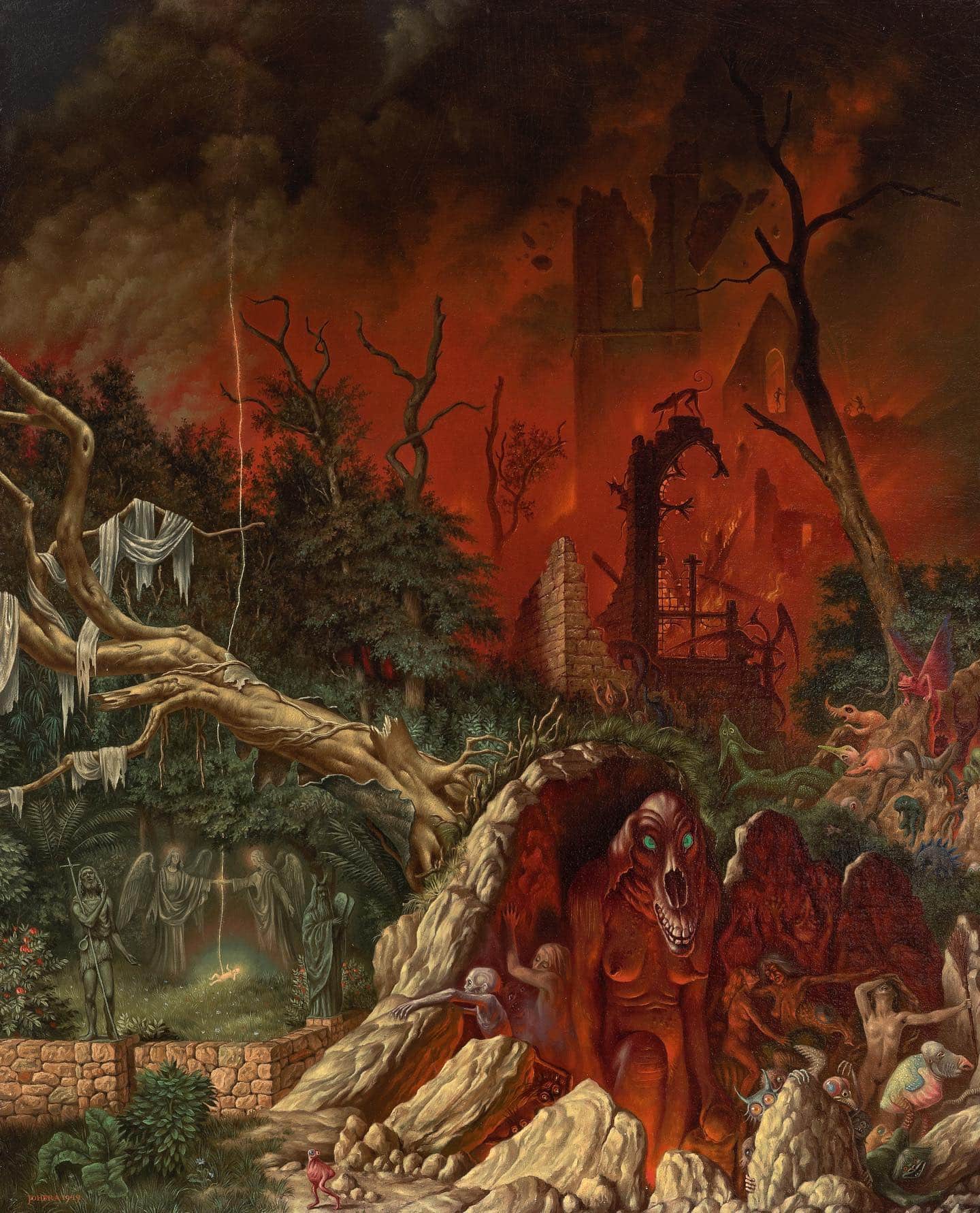
The German occupation of the Netherlands was a crucible for the young artist. Paradoxically, the occupation provided his first encounter with Surrealism via a Nazi propaganda magazine condemning "Entartete Kunst" (Degenerate Art). This introduced Johfra to Dalí, Magritte, and Ernst—a "celebration of recognition" that his private visions belonged to a broader tradition.
The Great Fire of 1945
The war ended with a cataclysm that Johfra viewed as divine intervention. On March 3, 1945, an Allied bombing raid destroyed his parental home. Approximately 400 paintings and 1,000 drawings were incinerated.
He called this "liberation." Emerging from the rubble, he adopted the pseudonym JOHFRA (an inversion of JOHannes FRAnciscus) and committed himself fully to his visionary path.
The First Muse and The Gnostic Path (1945–1962)
In 1946, Johfra met Diana Vandenberg. Their union was both romantic and spiritual. In 1953, the couple joined the Lectorium Rosicrucianum in Haarlem. For the next decade, Johfra’s art became inextricably linked to the brotherhood's doctrine of "Transfiguration"—the dismantling of the ego to release the divine spark.
The Encounter with Dalí (1959)
Johfra and Diana traveled to Port Lligat to meet Salvador Dalí. The meeting was a pivotal moment of disillusionment. While Johfra respected Dalí's technical genius, he was repelled by the surrealist's "boundless vanity." He realized his own path required a sincere, scientific exploration of the psyche, not theatricality.
The Second Muse and The Exodus (1962–1974)
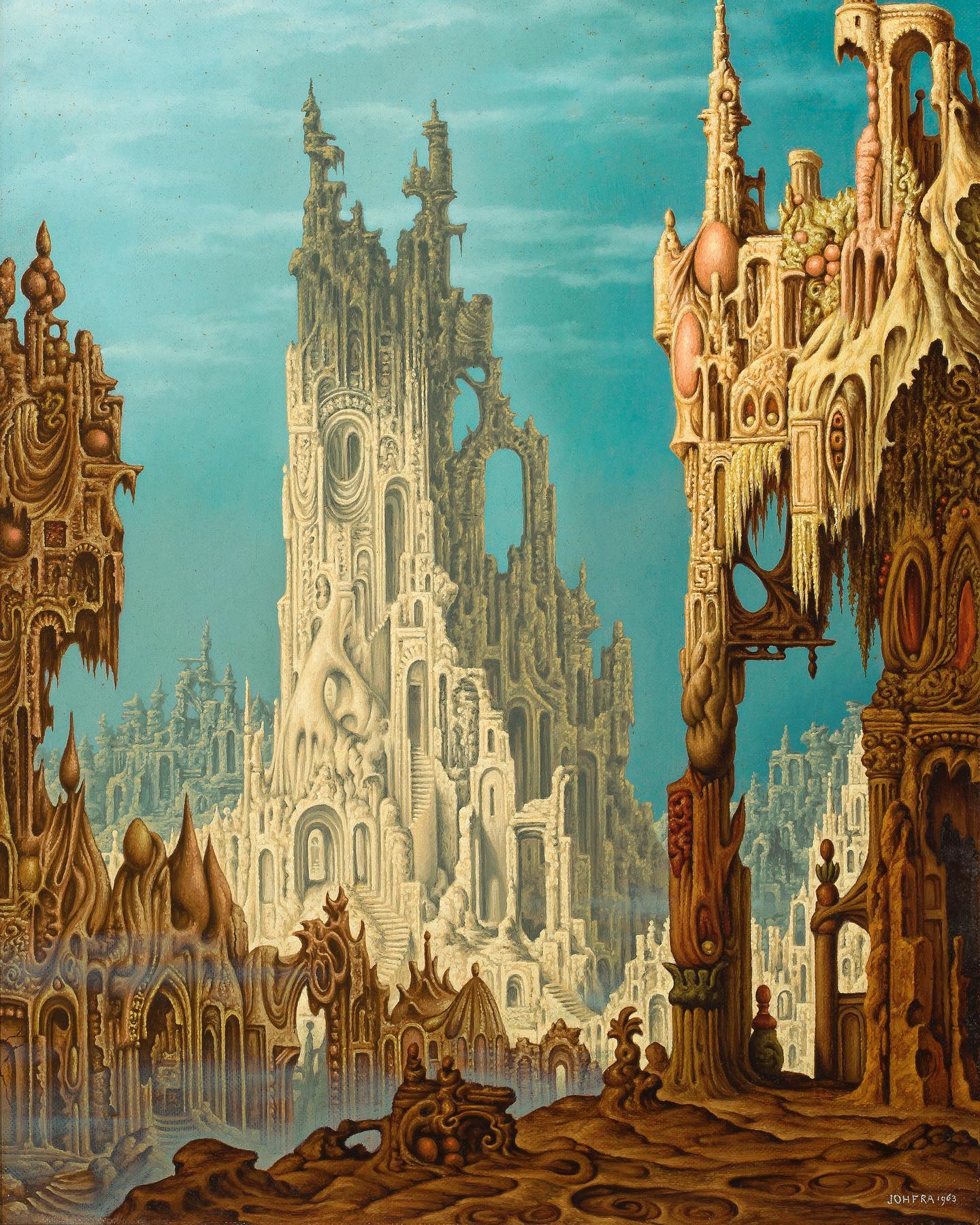
By the early 1960s, Johfra felt suffocated by rigid doctrines. In 1962, he left Diana and the brotherhood for a new muse: Ellen Lórien.
Together, they sought isolation, moving to Aspremont in the French Alps in 1964. They lived in a house Johfra built himself from demolition materials. This period marked a shift from Gnostic didacticism to a wilder, more organic style, confronting the "Shadow" psychology of Carl Jung in the grotesque Maldoror series.
"Ellen is the driving force and the inspiration of our community. She protects me from inner chaos... Without her I would have been lonely a long time ago." — Johfra
Meta-Realism and The Zodiac Phenomenon (1974–1976)
In 1973, critic Hein Steehouwer coined the term "Meta-realism" ("beyond realism"). The group, "The 7 Metarealists," launched exhibitions that attracted tens of thousands of visitors, stunning an art establishment that had ignored them.
Simultaneously, Engel Verkerke commissioned the Zodiac poster series. Johfra immersed himself in the project, painting from Pisces to Aries. The posters became a global phenomenon. While they brought financial independence, Johfra eventually grew weary of being labeled merely an "astrological artist," feeling it overshadowed his deeper hermetic works.
The Hermit of Moulin de Peuch (1974–1998)
In 1974, Johfra and Ellen moved to the Moulin de Peuch, an 18th-century water mill in the Dordogne. This prehistoric landscape became the setting for his final transformation.
He abandoned the Gnostic view of nature as "fallen." Instead, he embraced Pantheism, worshiping the "Great Mother." His studio became a Wunderkammer filled with skeletons, crystals, and driftwood. Here he produced monumental triptychs like The Adoration of Pan (1979), celebrating the chaotic life-force of the universe.
Homecoming (1998)
In 1998, diagnosed with terminal cancer, Johfra completed his final painting, Thuisvaart (Homecoming) and his autobiography.
Johfra Bosschart died on November 6, 1998.
His legacy remains that of a "psychonaut of the brush"—an artist who mapped the invisible continents of the human soul.
"Johfra is dead, long live Frans."
— Ellen Lórien